


How to Vet an AI-First Agency Before You Hire One
To vet an AI-first agency, evaluate how AI is used, not just whether it is used. The strongest agencies can explain which business problems AI solves, how workflows are customized to your brand, who provides human oversight at each stage, and how AI’s impact is measured in real business terms. Agencies that cannot answer those questions clearly are selling a label, not a capability.
Why AI-First Agency Claims Are Hard to Evaluate
Every agency in the market now claims to be AI-powered. The phrase has become table stakes in new business presentations, with little consensus on what it means or what it actually delivers.
The problem for buyers is not a lack of AI-fluent agencies. It is the absence of a reliable way to distinguish between agencies that have embedded AI into genuinely better strategy and execution, and those that have added AI terminology to a pitch deck without changing anything meaningful underneath.
Buyers who skip rigorous evaluation risk paying premium strategy fees for generic automation. They risk outputs that carry your brand’s voice but were never trained on your brand. They risk data handling practices that were never designed with enterprise privacy requirements in mind. And they risk entering a long-term engagement with no clear way to measure whether AI is making the work better or just faster.
Key Takeaway: An AI-first agency should be evaluated by the quality of its process, not the novelty of its tools.
What Is an AI-First Agency?
An AI-first agency is one that has integrated artificial intelligence into its core workflows rather than treating it as an occasional productivity shortcut. In practice, that can mean a range of things. Credible AI use in an agency context may include:
- AI-assisted content ideation, drafting, and optimization
- Custom large language model (LLM) workflows trained on client brand guidelines, product information, or audience data
- AI-powered audience research and segmentation
- Automated reporting that surfaces patterns and performance signals
- Predictive analytics for media planning and budget allocation
- Creative testing frameworks that use AI to prioritize variants
- Workflow automation that reduces low-value production work and frees senior talent for strategy
The key distinction is whether AI is embedded in how the agency thinks and builds, or simply layered on top of existing processes for the sake of positioning.
Pro Tip: Ask the agency where AI improves judgment, not just where it saves time. Any agency can point to speed gains. The better question is whether AI is making the strategic and creative decisions better.
What Is a Prompt-Wrapper Agency?
A prompt-wrapper agency is one that relies primarily on off-the-shelf AI tools or basic prompt templates while presenting them as proprietary or differentiated AI capability.
Using public AI tools is not inherently a problem. ChatGPT, Claude, Gemini, and similar tools are genuinely useful in professional workflows when applied with expertise and oversight. The issue is misrepresentation: charging strategic-tier fees for generic automation, claiming proprietary processes that are simply pre-written prompts, offering no customization to your brand or market, and providing no governance or quality controls beyond a surface review.
Warning signs that an agency may be a prompt-wrapper:
- Vague references to “our AI platform” with no explanation of what it actually does
- An inability to explain how AI outputs are reviewed or refined before delivery
- AI-generated content that sounds fluent but does not reflect your brand voice, category nuance, or audience
- No documented policy for data handling, IP ownership, or training data use
- Deliverables that are faster but not demonstrably better
- Resistance to explaining which tools are used and why
The AI-Accountability Framework: 7 Questions to Ask Before Hiring an AI-First Agency
1. What Business Problem Is AI Actually Solving?
Strong AI use starts with a problem, not a tool. An agency that has integrated AI strategically can tell you exactly which parts of their process AI has made better, and why that matters to client outcomes. An agency that starts with the tool and works backward is optimizing for efficiency rather than effectiveness.
Ask: What specific client outcomes have you improved because of AI, not just what processes have you automated?
Strong answer: The agency names a concrete problem (audience segmentation accuracy, content testing velocity, reporting latency) and explains how AI addressed it with measurable results.
Red flag: The agency describes AI in terms of output volume or speed without connecting it to business performance.
2. Is the AI Workflow Custom or Generic?
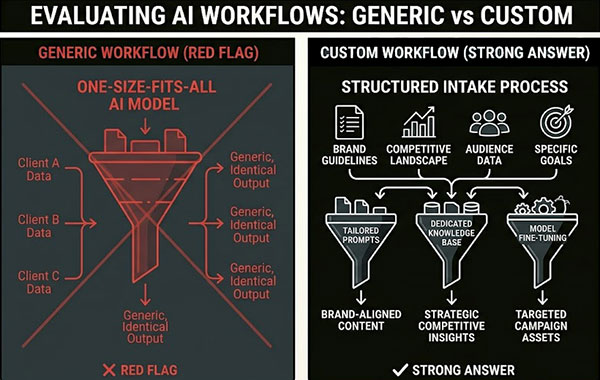
A generic AI workflow treats every client the same way. A custom workflow is built around your brand guidelines, your competitive landscape, your audience data, and your specific goals. The difference shows up immediately in output quality, but it is almost invisible in a pitch presentation.
Ask: How do you customize your AI workflows for a new client? What does that onboarding process look like, and how long does it take?
Strong answer: The agency describes a structured intake process that involves building or adapting prompts, knowledge bases, or model fine-tuning around client-specific inputs.
Red flag: The agency cannot describe a customization process that meaningfully differs from one client to the next.
3. How Do You Protect Our Data, IP, and Brand Assets?
When a client’s brand guidelines, customer data, proprietary research, or unreleased product information enters an AI workflow, questions of privacy, IP ownership, and data security become immediate business risks. Most public AI tools have default settings that are not appropriate for enterprise or regulated-industry use.
Ask: Which AI tools or platforms do you use, and what are your data handling practices? Who owns the AI-generated outputs? Are our inputs ever used to train models?
Strong answer: The agency has documented policies that cover data privacy, output ownership, confidentiality, and appropriate tool configurations for enterprise use.
Red flag: The agency cannot answer data handling questions specifically, deflects to the tool vendor’s terms of service, or does not have a written AI governance policy.
4. What Human Oversight Exists at Each Stage?
AI produces outputs. Humans are responsible for judgment, accuracy, brand integrity, strategic alignment, and accountability. An agency that has built AI into a workflow without defining clear human review checkpoints is not running a managed AI process. It is running an AI process that happens to have humans somewhere nearby.
Ask: Who reviews AI-generated work before it reaches us? What is that person’s role, and what are they specifically checking for?
Strong answer: The agency describes specific review stages tied to specific roles, including checks for factual accuracy, brand alignment, strategic fit, and legal or compliance requirements where applicable.
Red flag: Review is described as a general quality check rather than a structured process with defined accountability.
5. Can the Agency Explain Its Model, Tool, and Vendor Choices?
A competent AI practitioner can explain what they use, why they chose it, and what its limitations are. Opacity about tooling is a meaningful signal. It may indicate that the agency lacks depth in AI strategy, that it is concerned about revealing how commoditized its process actually is, or that it has not thought carefully about fit between tool and task.
Ask: What AI tools and models do you use in your workflows, and why did you choose them over alternatives? What are their known limitations for work like ours?
Strong answer: The agency can name specific tools, explain the rationale for each, and discuss trade-offs candidly. Bonus points for acknowledging specific limitations.
Red flag: The agency is vague about tooling, describes it as proprietary without elaboration, or becomes defensive when pressed.
6. How Do You Measure AI’s Impact?
Speed is not strategy. If an agency’s primary metric for AI success is how much faster they can produce deliverables, they are measuring the wrong thing. High-value AI integration should improve the quality of decisions, the accuracy of insights, the relevance of creative, the efficiency of spend, or the performance of campaigns. Buyers should hold agencies to the same measurement standard for AI that they hold them to for everything else.
Ask: How do you measure whether AI is actually improving outcomes for your clients? Can you show us examples?
Strong answer: The agency has defined metrics for AI-related performance improvements and can point to documented examples where AI contributed to better business outcomes.
Red flag: The agency describes AI value exclusively in terms of production efficiency or cost savings, with no link to client performance.
7. How Transparent Will You Be About AI Use?
Transparency is not just an ethical consideration. It is a practical one. You need to know when AI is used in work delivered under your brand’s name, particularly for regulated industries, sensitive topics, or content that carries legal or reputational risk. You also need the ability to set restrictions, request disclosure documentation, and maintain governance over what AI is permitted to do on your behalf.
Ask: Will you disclose to us when AI is used in client work? Can we set restrictions on AI use for specific content types or channels?
Strong answer: The agency has a clear disclosure policy, supports client-specific AI-use restrictions, and can provide documentation of how AI was used on any deliverable.
Red flag: The agency treats disclosure as unnecessary, frames AI transparency as a competitive concern, or cannot support client-defined governance requirements.
AI-First Agency Red Flags to Watch For
A summary checklist for buyers in RFP, discovery, or contract review:
- Vague references to “proprietary AI” with no explanation of what it does
- No documented AI governance or data handling policy
- No defined human review process for AI-generated outputs
- Overemphasis on speed, volume, or output quantity
- Generic deliverables with no evidence of brand or audience customization
- Inability to explain data privacy, IP ownership, or training data use
- No measurable link between AI use and business outcomes
- Senior strategists absent from AI workflow design and oversight
- Defensiveness or deflection when asked about tooling or process
- Case studies that describe activity and deliverables but not client results
Key Takeaway: The biggest red flag is not that an agency uses AI. It is that the agency cannot explain how AI is governed, reviewed, and connected to measurable business value.
What a High-Value Custom LLM or AI Workflow Looks Like
For contrast, here is what thoughtful, client-specific AI integration typically looks like in practice:
- A custom knowledge base built from your brand guidelines, messaging frameworks, product documentation, and sales materials, used to ground AI content outputs in your actual brand
- AI-assisted audience research that draws on real customer data, CRM insights, or category research rather than generic demographic proxies
- Content workflows with structured brand, legal, and human editorial review before any output is published or submitted
- AI-powered reporting that surfaces performance patterns, anomalies, and optimization signals rather than just repackaging raw data
- Decision-support tools for campaign planning that help teams evaluate scenario options based on historical performance signals
- Creative testing frameworks that use AI to rank and prioritize variants based on meaningful performance data, not random distribution
Pro Tip: A high-value AI workflow usually creates better decisions, not just more deliverables. If an agency’s AI story is primarily about output volume, ask what happened to output quality.
Questions to Ask in an RFP or Discovery Call
Use this checklist when evaluating any agency that positions itself as AI-first or AI-powered:
- What specific business problems has your AI use solved for clients? Can you show results?
- How do you customize your AI workflows for a new client, and what does that process involve?
- Which AI tools and models do you use, and why did you choose them?
- What are the known limitations of the AI tools you use for work like ours?
- Who owns the outputs generated with AI during our engagement?
- How is our data handled, stored, and protected when it enters your AI workflows?
- Is our data ever used to train models, either your own or third-party vendors?
- What is your human review process for AI-generated content or recommendations?
- Who is the senior person accountable for AI quality on our account?
- Do you have a documented AI governance or acceptable-use policy you can share?
- Will you disclose to us when AI is used on specific deliverables?
- Can we restrict AI use for certain content types, channels, or brand contexts?
How TAG Helps Brands Evaluate AI-First Agencies
Finding an agency that claims AI capability is not difficult. Finding one whose AI process is genuinely customized, properly governed, transparently disclosed, and tied to measurable outcomes is a harder problem, especially when buyers do not have a structured way to evaluate it.
TAG works with brands and marketing leaders to cut through agency positioning and evaluate what is actually on offer.
That includes helping buyers clarify their requirements before the search begins, building evaluation criteria specific to their industry and use case, and assessing agency fit across strategy, execution, oversight, and accountability, not just tool usage.
If you are in the process of evaluating AI-first agencies or trying to structure an RFP that goes beyond surface-level claims, TAG can help you ask the right questions and read the answers accurately.
FAQ: Vetting an AI-First Agency
What should I ask an AI marketing agency before hiring one?
- Start with these four questions: What business problem does your AI use to solve? How do you customize workflows to our brand? Who provides human oversight at each stage? How do you measure AI’s impact on client outcomes? The quality of those answers will tell you more than any tool demonstration.
How can I tell if an agency is just using ChatGPT?
- Ask them to walk you through their AI workflow in detail. If the answer amounts to writing prompts and reviewing outputs, with no customization layer, no proprietary training, no structured governance, and no defined review process, you are looking at a basic prompt workflow regardless of how it is positioned. That is not necessarily disqualifying, but it should be priced and evaluated accordingly.
Are AI-first agencies better than traditional agencies?
- AI integration alone does not determine agency quality. A traditional agency with deep category expertise and strong strategic thinking will outperform an AI-first agency that applies generic automation to every client. The better question is whether the specific agency you are evaluating uses AI in ways that improve the strategy, quality, and results of the work, not just the speed of production.
What is the biggest risk of hiring an AI-first agency?
- The biggest risk is misalignment between what the agency claims AI does and what it actually does in practice. This creates three downstream problems: outputs that do not reflect your brand, data handling that does not meet your standards, and no clear accountability when AI-generated work causes an issue. Rigorous vetting before signing reduces all three.
Should an agency disclose when it uses AI?
- Yes. Disclosure is standard practice for agencies operating with appropriate governance. You have a legitimate interest in knowing when AI was used in work delivered under your brand’s name, particularly for content, research, and recommendations that carry reputational or regulatory risk. Any agency that resists reasonable disclosure requirements is signaling that its governance posture does not match its AI ambitions.